
 Bitaigen Research
In this article we examine common misconceptions about the relationship between Bitcoin prices and technology stocks, combine the latest research to clarify the underlying drivers, and provide a more objective analytical framework. This helps readers interpret market signals, gain a deeper understanding of the true logic behind Bitcoin’s price movements, and encourages continued reading.
Bitcoin’s price “cannot be explained by stocks”
Since Bitcoin broke its historic high of USD 126,000 in early October last year, its correlation with the U.S. software sector has been on an upward trend over the past 90 days. At the same time, data from NYDIG also show that Bitcoin’s correlation with the S&P 500 and the Nasdaq has risen, indicating that this synchronization is not unique to software equities.
Nevertheless, NYDIG’s research director Greg Cipolaro emphasizes that the majority of Bitcoin price fluctuations remain difficult to explain with the equity market. He notes that statistical results indicate only about 25 % of Bitcoin’s price movement can be attributed to its correlation with the stock market, while the remaining over 75 % is driven by other, non‑traditional factors.
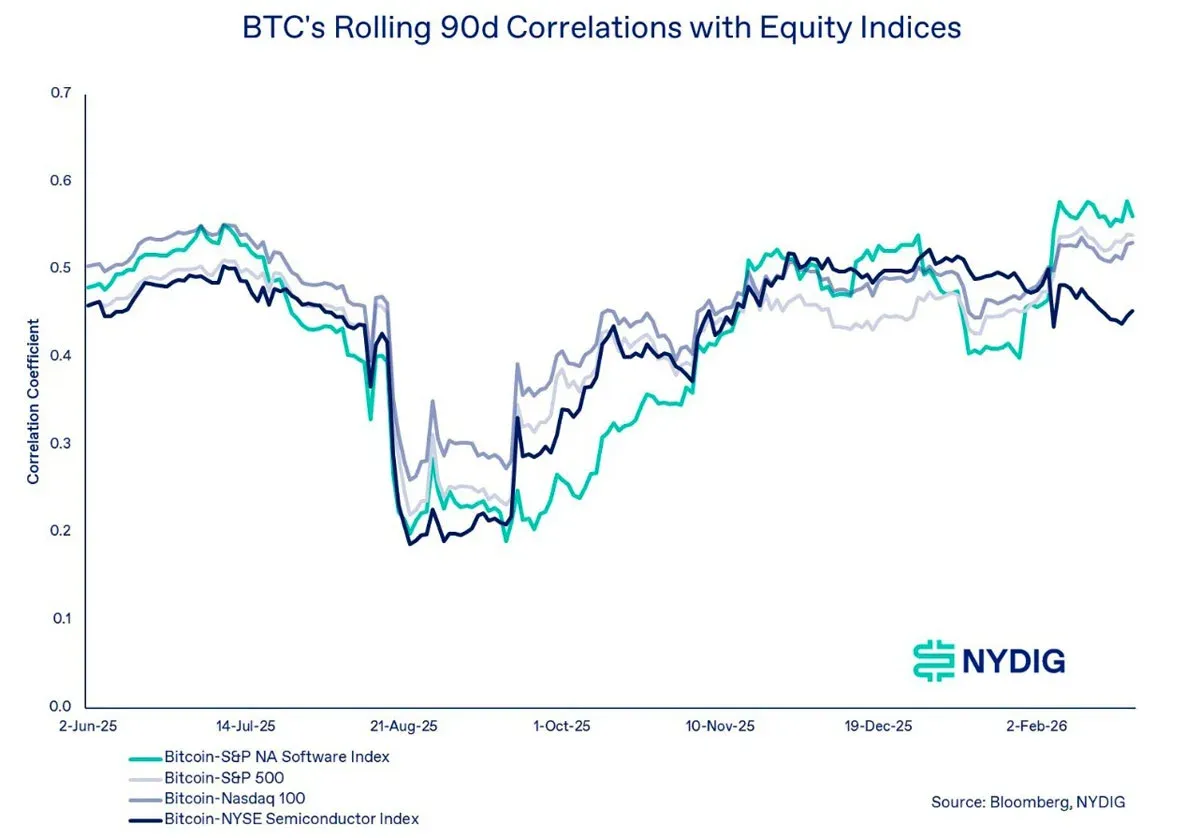
*90‑day rolling correlation of Bitcoin with major indices. Source: NYDIG*
Cipolaro further explains that Bitcoin is not viewed as a macro‑economic hedge, which is one reason it does not behave like gold despite being labeled “digital gold.” He believes market participants tend to allocate assets along a risk curve rather than hold Bitcoin based on a so‑called “unique monetary thesis.”
NYDIG’s view on Bitcoin‑tech stock synchronicity
Financial‑services firm NYDIG argues that the recent parallel movement of Bitcoin and U.S. software stocks is more a joint exposure to the same macro‑economic events than a structural convergence between the two asset classes. The firm points out that this parallelism resembles a common reaction to the macro environment rather than an intrinsic link between the assets themselves.
Last week, Bitcoin and U.S. software stocks rose in tandem, prompting many observers to brand Bitcoin as a benchmark asset for the sector. In a report, Cipolaro cautioned: “Although the price charts look visually similar, treating Bitcoin and software stocks as a structural convergence—or assuming they share common exposures to themes such as artificial intelligence or quantum risk—has been overstated.”
He added that this dual‑direction rally “more likely reflects a shared exposure to the current macro‑economic backdrop, especially for risk assets that are sensitive to long‑term liquidity,” rather than an inherent synchronization between Bitcoin and software equities.
Bitcoin’s unique driving forces
Cipolaro believes Bitcoin possesses a distinctive market structure and economic drivers, including its network activity, adoption trends, and interaction with regulatory policies. These factors set it apart from traditional assets. He states: “This differentiation supports Bitcoin’s role in portfolio diversification. Even when cross‑asset and equity correlations are temporarily elevated, they are insufficient to determine Bitcoin’s overall return profile.”
---
*Note: For U.S. residents, cryptocurrency trading should be conducted on Binance.US rather than the global Binance platform. Fiat transactions in the global market are typically processed via USD, SEPA, or SWIFT channels.*
💡 Register on Binance with referral code B2345 for the maximum trading fee discount. See Binance complete guide.



